Istanbul Archaeology Museum: Tombs, Sarcophagi, and the Civilizations That Shaped Turkey
If you want to understand Turkey in one afternoon, start where empires left their fingerprints in stone: the Istanbul Archaeological Museums complex, next to Gulhane Park and Topkapi Palace. This is not just “an Istanbul museum.” It is a gateway to the archaeology of Anatolia (modern Turkey) and the ancient Near East—built to protect and display world-class finds, including the legendary sarcophagi brought to Istanbul after late-19th-century excavations.
For travelers planning a Turkey tour, adding the Istanbul Archaeology Museum is an easy upgrade: it deepens every later stop on your itinerary—Ephesus, Pergamon, Troy, Cappadocia, Gobekli Tepe—because you begin recognizing styles, symbols, languages, and the “big ideas” that moved across continents.
What is the Istanbul Archaeological Museums complex?
The site is a three-part museum complex (often shortened in conversation to “Istanbul Archaeology Museum”). It was founded under Osman Hamdi Bey, opened to visitors in 1891, and the main building was designed by architect Alexandre Vallaury (later expanded in the early 1900s).
One reason it became so important: it was created to properly exhibit major discoveries—especially the famous sarcophagi transported to Istanbul from the Sidon royal necropolis excavations (1887–1888).
If you are doing a private and guided Istanbul tour, this museum pairs perfectly with the nearby Old City highlights—because it gives context for what you see in the streets, basilicas, cisterns, and palace collections.
The museum’s tombs: why the sarcophagi matter
When people say “the museum’s tombs,” they usually mean the funerary masterpieces—especially the Sidon sarcophagi. A sarcophagus is a stone coffin, often carved like a sculpture-filled storybook. In the ancient world, tombs were not only about death; they were about identity, power, and memory.
The Sidon Sarcophagi Hall: a world-class funerary collection
From the Sidon royal necropolis excavations, the museum exhibits several iconic pieces, including the:
Alexander Sarcophagus
Tabnit Sarcophagus
Crying / Mourning Women Sarcophagus
This 1887 discovery of the Sidon necropolis is often described as a major high point of archaeology within the Ottoman Empire, widely noticed even at the time.
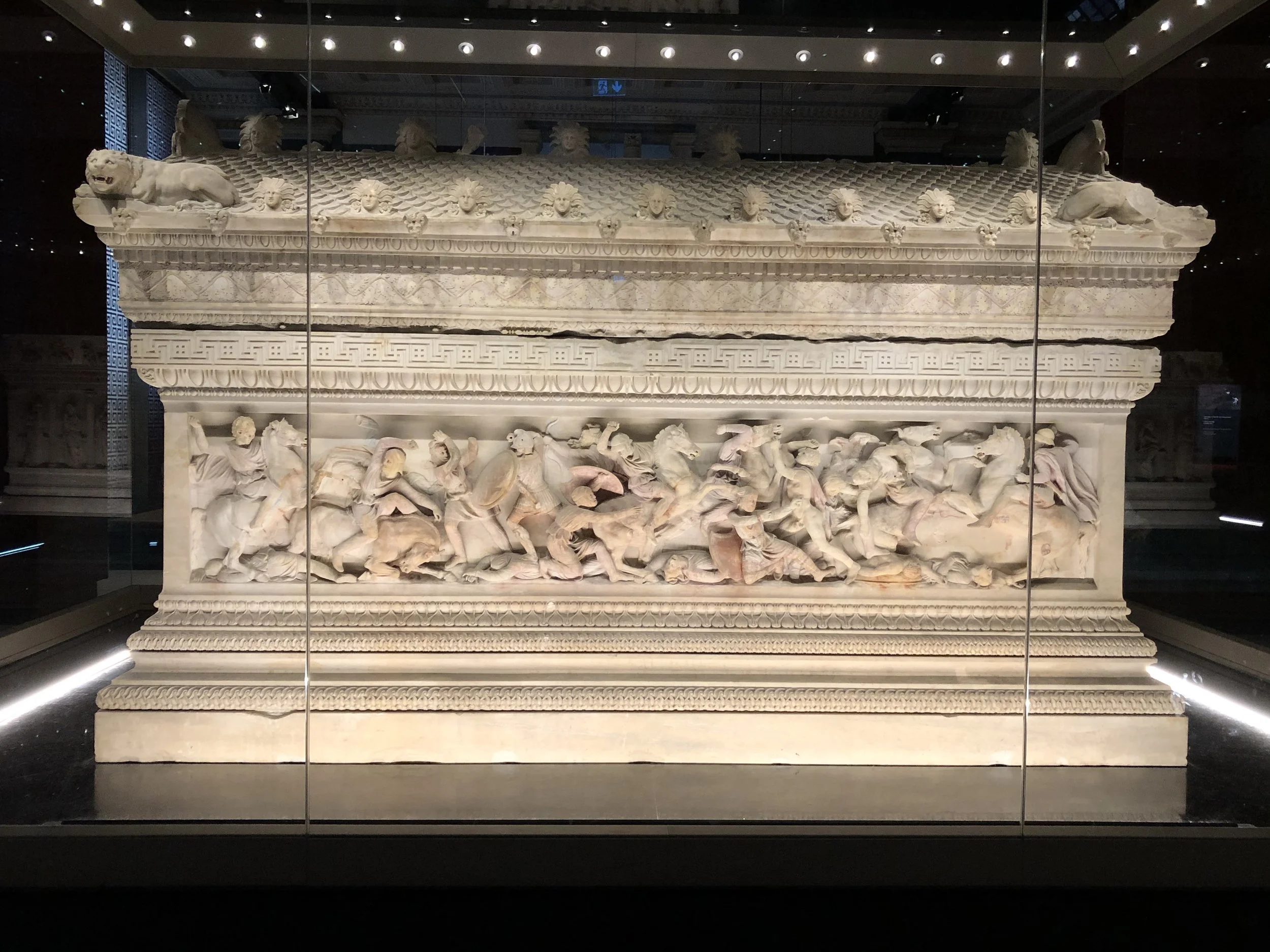
The Alexander Sarcophagus (the headline “tomb”)
the Alexander Sarcophagus
Despite the name, the “Alexander Sarcophagus” is famous because of its dramatic relief scenes (war and hunting) where Alexander is depicted, not because Alexander was buried inside. The museum’s own summary notes it was found in Sidon in 1887 and dates to the 4th century BC, with scenes linked to the Battle of Issus.
Why it matters globally: it shows how politics, art, and identity blended across cultures—Greek style, Persian subjects, Phoenician royal context—exactly the kind of cultural “mixing” that defines Anatolia and the eastern Mediterranean.
The Mourning Women (Crying Women) Sarcophagus
This is one of the most emotionally powerful objects in the museum: carved figures captured in grief. It is also listed among the key Sidon pieces in the museum complex description.
Why it matters: it humanizes antiquity. You stop seeing “ancient people” as distant names—and start seeing them as families, rituals, and real loss.
Other “tomb highlights” worth asking your guide about
the Sidamara Sarcophagus
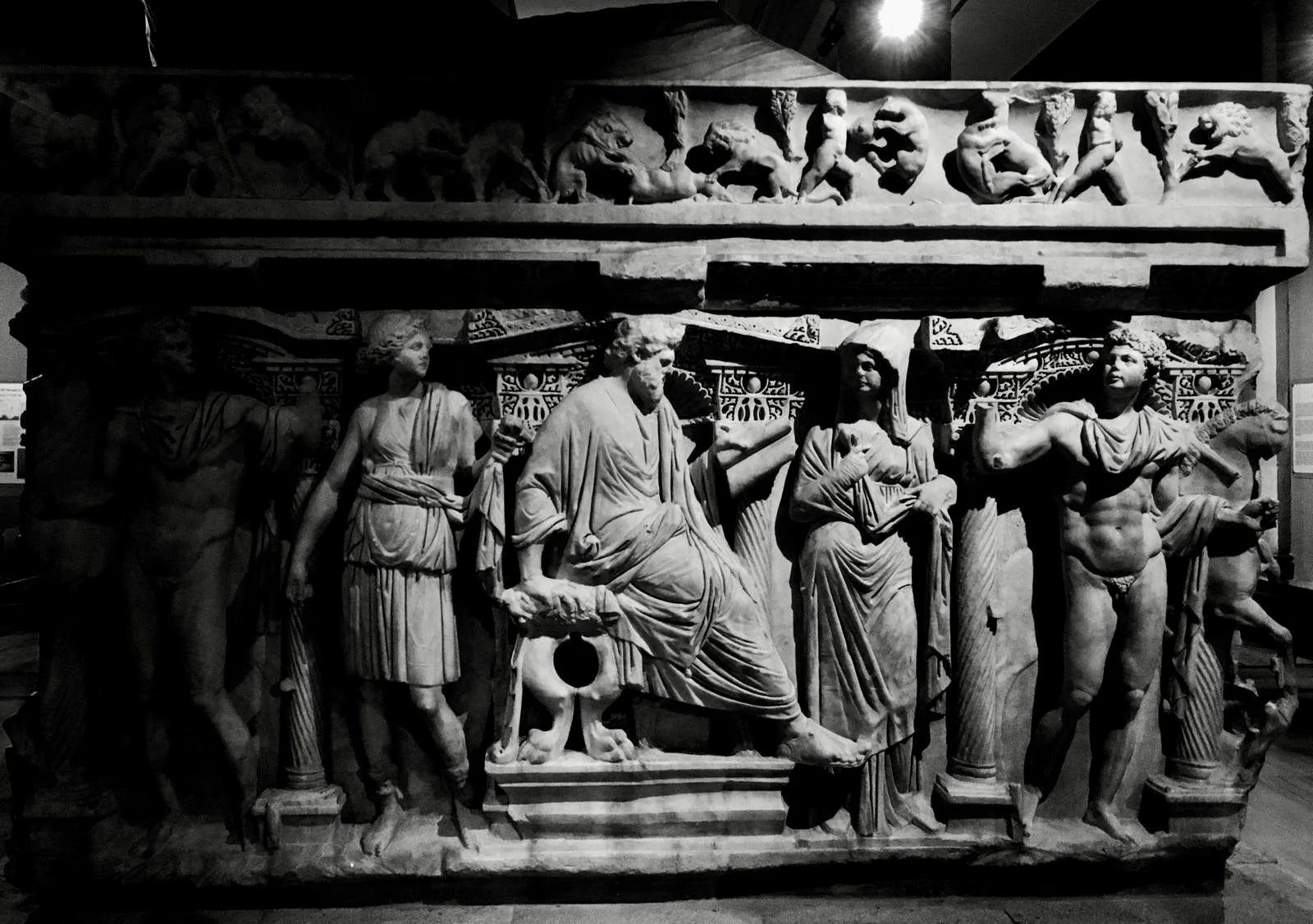
Beyond Sidon, the complex is full of funerary archaeology from Anatolia. One standout often highlighted by the official museum blog is the Sidamara Sarcophagus (found near Konya), noted for its scale and elaborate mythological scenes.
If your goal is a more meaningful Istanbul tour, these tomb artifacts are the fastest way to connect art, religion, empire, and everyday life—because burial customs preserve what societies valued most.
Turkey’s archaeology in one idea: Anatolia as a crossroads
Archaeologically, Turkey is unmatched because it sits between:
Europe and Asia
the Black Sea and the Mediterranean
major trade routes, armies, and faiths
That geography made Anatolia a laboratory of civilizations: people settled early, built cities, traded, fought, mixed, wrote laws, minted coins, and developed art that traveled outward.
Ancient civilizations that lived in Turkey and what they contributed
Here’s a practical “who’s who” for travelers planning a custom-made Turkey tour (and what each group contributed to the global story).
Neolithic pioneers (early settled life)
Gobekli Tepe region (southeast Turkey): among the earliest monumental ritual landscapes, reshaping how we think about the origins of complex society.
Catalhoyuk (central Anatolia): early dense settlement with rich symbolic life.
Global role: these sites help answer the biggest question in archaeology—how humans moved from mobile life to towns, ritual centers, and agriculture.
Hittites (Bronze Age superpower)
Capital at Hattusa (Bogazkale).
Diplomacy, treaties, imperial administration.
A famous museum highlight linked to this era is the Kadesh Peace Treaty Tablets, described as the first known peace treaty, and displayed in Istanbul.
Global role: early international diplomacy—state-to-state agreements and political balance.
Trojans and the world of the Aegean Bronze Age
Troy (Hisarlik) anchors epic storytelling and real archaeology.
Global role: connects myth, literature, and the reality of strategic maritime trade routes.
Phrygians and Lydians (Anatolian kingdoms of innovation)
Phrygians (Gordion, King Midas legends).
Lydians (Sardis): often associated with early coinage traditions in the ancient world.
Global role: economic innovation and cultural exchange across the Aegean and Near East.
Urartu (Eastern Anatolia)
Fortresses and advanced stonework around Lake Van.
Global role: shows a distinct highland kingdom with sophisticated engineering and regional power.
Greeks (Ionian, Aeolian, Doric cities in western Turkey)
Cities like Ephesus, Miletus, Pergamon.
Philosophy, science culture, theaters, urban planning.
Global role: ideas (and city life) that shaped Mediterranean civilization.
Persians (Achaemenid Empire influence)
Anatolia as a key imperial region, with royal roads, satrapies, and multicultural administration.
Global role: large-scale governance across vast territories.
Romans and Byzantines
Roman urban infrastructure, law, roads, and monumental architecture.
Byzantine Christianity, art, and imperial continuity centered at Constantinople (Istanbul).
Global role: statecraft, religion, and urban life that shaped Europe, the Middle East, and beyond.
Seljuks and Ottomans (medieval to early modern layers)
While “archaeology” often focuses on ancient eras, Turkey’s material history continues through Seljuk architecture and Ottoman heritage—adding layers that make a Turkey tour feel like time travel.
“What have they discovered?” Turkey’s greatest archaeological stories (and how to tour them)
Turkey’s archaeology isn’t just “old stones”—it’s discoveries that changed textbooks:
Origins of monument-building and ritual in southeast Anatolia (Gobekli Tepe region)
Hittite imperial archives and diplomacy (Hattusa and related sites; Kadesh tradition)
Greco-Roman city life at its peak (Ephesus, Aphrodisias, Pergamon)
Troy’s multi-layered city history (where myth meets excavation)
A smart custom-made Turkey tour links museum context in Istanbul with 2–3 archaeological regions afterward, instead of trying to “do everything.”
How to visit: build it into a private and guided Istanbul tour
Best pairing (high impact, low walking stress):
Topkapi Palace area + Gulhane Park + Istanbul Archaeology Museum complex
Because the museum was created specifically to display major imperial-era collections (including the Sidon sarcophagi), it fits the Old City narrative perfectly.
If you want the visit to feel effortless, book a private and guided Istanbul tour so your guide can:
explain the tomb iconography (who is shown, why they’re posed that way)
connect objects to sites you may visit later on your Turkey tour
keep the story coherent (instead of “room-by-room confusion”)
FAQ
Is the Istanbul Archaeology Museum good for first-time visitors?
Yes—because it summarizes Anatolia’s big story fast, and the sarcophagi galleries are unforgettable.
What are the “famous tombs” in the museum?
The most famous “tombs” are the Sidon sarcophagi, especially the Alexander Sarcophagus, plus the Tabnit and Mourning/Crying Women sarcophagi.
Can this be part of an Istanbul tour focused on history?
Absolutely. It’s one of the best add-ons for a history-heavy Istanbul tour, especially when combined with Topkapi and the Old City tour.
Want a museum day that actually makes sense?
Want the Istanbul Archaeology Museum explained like a story—not a textbook? We offer private and guided Istanbul tours with a licensed local guide, flexible timing, and fully custom-made Turkey tour options if you want to continue to Ephesus, Troy, Pergamon, or Cappadocia.
Contact us to customize your museum day in Istanbul.